What are sequencing skills?
Sequencing means putting ideas or events in the correct time order – what happened first, what happened next, and what happened last. This skill helps children to:
- Tell stories clearly
- Explain what happened in their day
- Follow and give instructions
- Recognise patterns and make predictions
- Understand cause and effect (what happens because of something else)
How you can help your child at home
Sequencing Reading Questions:
- What happened first in the story?
- What happened after that?
- Can you tell me what happened at the end?
- Can you put these parts of the story in the right order?
- What happened before this part?
- Can you tell me the story from the beginning to the end?
- If we told this story to someone else, what order should we say things in?
Sequencing Activities:
Talk about what happened in the story
When you read a book with your child, it’s a good time to talk about the order of events. After reading, ask:
- What happened first?
- What happened next?
- How did the story end?
You can write each part of the story on a small card or lollypop stick. Then, ask your child to put them in the right order.
Encourage them to use sequencing words such as: first, next, then, after that, finally.
What did we do today?
At the end of the day, sit down with your child and say:
- “Let’s remember what we did today, in the right order!”
- Start with your own version: “First, we got up and had breakfast. Then we went to the park. After that, we had lunch…”
Then ask your child to tell you what they remember in order.
Timeline worksheet
Click on the worksheet below to open it full size
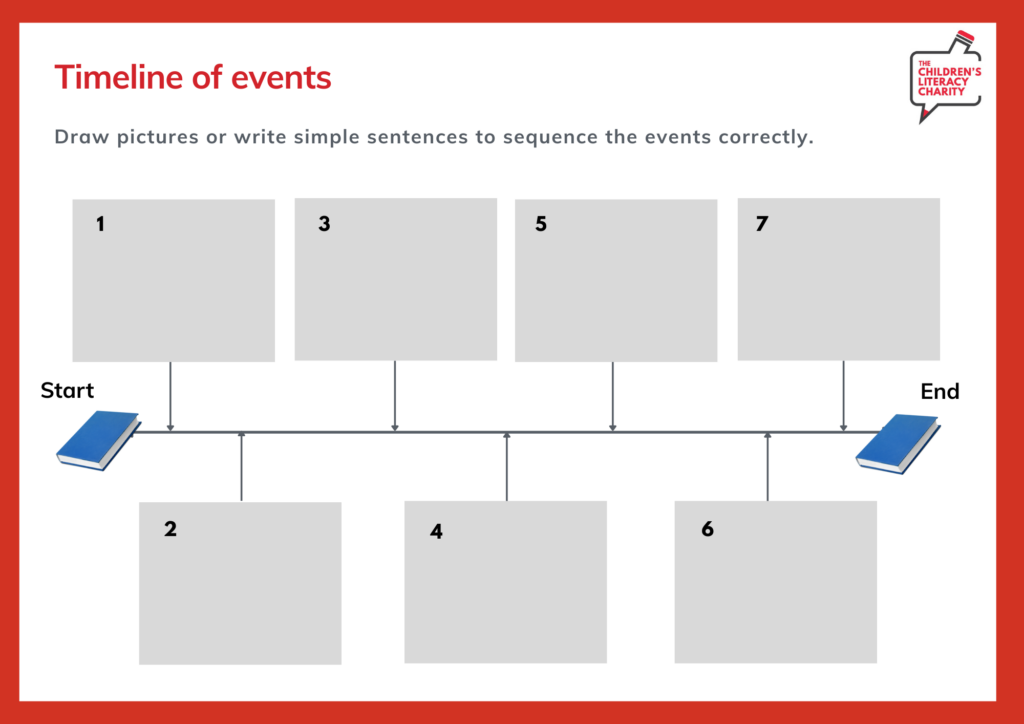
Sequence a picture story
Take a piece of paper and draw 4 big boxes on it. For older children, you can add more boxes.
Choose something your child knows well, like brushing teeth or making a sandwich.
Ask your child to draw what happens step by step — one picture in each box, showing what happens first, next, and last.
Match the number to the event
For older children:
- Write out the numbers 1 – 5 in order
- They write the main events from the chapter they have next to each number
- Next, you write out five events in a jumbled order
- Your child has to number the events correctly
- As they become more confident, add more events