
Use our vocabulary boosters to become a Word Wizard!
You can use this Word Detectives worksheet and the tips below it to help build your vocabulary.
You can also open the worksheet to print it out here.
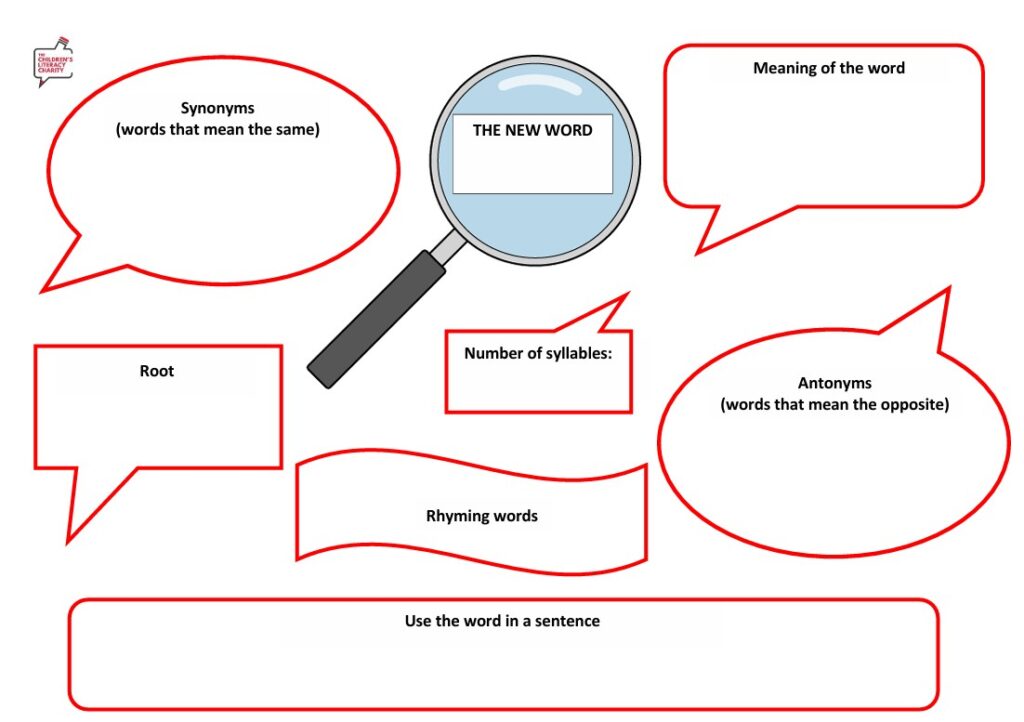
Be a Vocabulary Detective
When you’re reading and spot a word you don’t know, don’t panic — investigate!
Choose a word from the book that you are reading that is new to you. Use these clever strategies to help you find the meaning.
Read the whole sentence.
Look carefully at the words around the tricky word. They often give you clues to help you work out the meaning.
Example: arid
The arid desert stretched for miles, with not a single drop of water in sight.
The words “desert” and “not a single drop of water” help us work out that arid means dry.
2.) Break the word into parts.
Some words are made up of prefixes, roots, and suffixes. These parts can unlock the meaning.
Example: disobeyed
The girl disobeyed her mother all the time.
We know “dis” means not or the opposite, so disobeyed means she was not listening or following instructions.
3.) Look closely at the word itself. Can you split it into smaller, familiar words?
Example: threadbare
He wore a threadbare jacket.
A thread is a thin strand of material and bare means uncovered, so threadbare tells us the jacket is old and worn out.
Be a Vocabulary Master
Now you know what the word means, it’s time to lock it into your brain! Try these fun ways to practise:
Draw the word
Can you draw a picture to show what the word means? Pictures help your brain remember!
Example: Draw a cracked, dusty desert for arid.
Synonyms and Antonyms
Make a list of synonyms (words with the same or similar meaning) and antonyms (words with the opposite meaning).
Word: arid
Synonyms: dry, parched, barren, waterless, drought-stricken
Antonyms: moist, wet, humid, damp, rainy, lush
Word scale
Put it on a word scale. Is your word weak, medium, or strong? Place it on a scale with similar words.
Example: dry → arid → drought-stricken
Use it in a sentence
Show you really understand the word by using it correctly in your writing.
Example: arid
We walked, exhausted, through the arid, drought-stricken land.
Teach it
Teach the word to someone else. Explain the word to a partner, a sibling, or even a grown-up. If you can teach it, you really know it!
Use it or lose it!
The more you use a word, the stronger it sticks! Use your new word as much as you can — when you’re talking to someone, when you’re writing, or just trying it out in your thoughts. Can you spot it in books, on posters, or in lessons?